Verwey Woods in Schoorl: a grey heron colony in two bequeathed woods
The Verwey Woods are two small wooded plots on the eastern edge of Schoorl, managed by Landschap Noord-Holland, with a colony of grey herons in the old beeches. They are named after the biologist Jan Verwey, who bought part of the wood with a villa here in 1950, not after his father, the poet Albert Verwey.
Beheerder
overig
Two small wooded plots on the eastern edge of Schoorl, with a colony of grey herons in the old beeches. Landschap Noord-Holland, a regional nature conservation organisation, was left both of them and deliberately keeps the planting dense. The area is open along the roads and paths.
Where are the Verwey Woods?
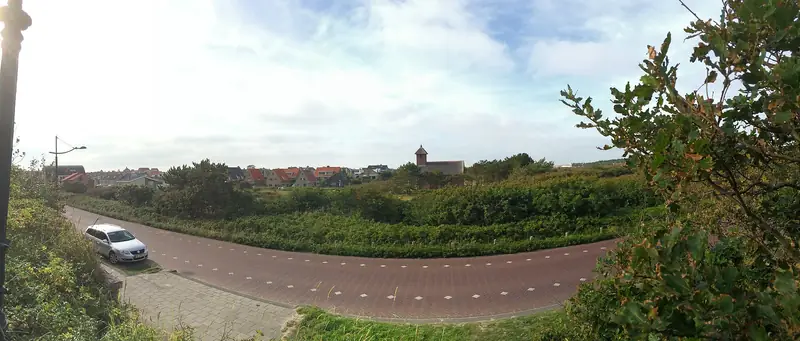
On the eastern edge of Schoorl, by the Dokter Heringalaan. Note that spelling. Landschap Noord-Holland puts “Dokter Herlingalaan” on its own area page, and according to the government address register (the BAG, queried through the PDOK location server) that street exists nowhere in the Netherlands. The Dokter Heringalaan in Schoorl does exist, postcode 1871 BG, and runs past a good hundred metres from the wood.
You are on the village side here, not in the dunes. The Klimduin lies about 1.1 kilometres to the west, measured between the map coordinates of the two.
Is the wood named after the poet Albert Verwey?
No, after his son. Landschap Noord-Holland writes that Jan Verwey bought part of the wood with a villa in 1950. That is the biologist Jan Verwey, 12 May 1899 to 24 September 1981, and according to the memorial notice published after his death by the KNAW, the Royal Netherlands Academy of Arts and Sciences, his father was indeed the poet Albert Verwey (1865 to 1937) and his mother Kitty van Vloten.
That the biologist really was in Schoorl is established independently of the manager’s page: the Noordwijk bird study group writes in its journal De Strandloper that Verwey lived in Schoorl for years after his retirement, and biographical sources give Schoorl as his place of death. The confusion with the poet is understandable, then, but the name on the map is the son’s.
Why do grey herons breed here?
Landschap Noord-Holland writes that Verwey used to feed grey herons in his garden, and then asks itself whether that is the reason they still nest there today. It leaves that question open. So do we, because we have found an answer nowhere.
What belongs with it: herons were no chance hobby of this man. According to the KNAW memorial notice he published a study in 1930 on pair formation in the grey heron that has become a classic in behavioural biology. He made those observations in 1924 from a window of his house on Goeree, an island in the province of Zuid-Holland, not here.
What else grows and sings there?
Old beeches set the character. Landschap Noord-Holland leaves dead trees standing for fungi and insects, and keeps the planting dense because birds like to breed in it. As for species, the manager mentions the nuthatch, the treecreeper and the woodpecker. Which species of woodpecker that is, it does not say.
Can you walk there, and can the dog come?
Walking is allowed. “The area is accessible along the roads and paths”, says the manager’s area page. It names no opening hours, and no entrance fee either.
About dogs that page says nothing, and a general code of conduct for all Landschap Noord-Holland sites is something we could not find on their website. So assume the signs at the entrance are what counts. During the breeding season there is a colony above your head in any case, and that is no place to let a dog run loose.
How big are the Verwey Woods?
That we have not been able to establish. Landschap Noord-Holland names no area and speaks only of two pieces of land that were bequeathed to it. OpenStreetMap draws one polygon there, way 107875511, and that polygon works out at 0.66 hectares, roughly 145 by 90 metres. The second wood is not on the map as a separate nature area.
So we have no total in hectares, and we are not inventing one. Small it is in any case: this is a green spot on the edge of the village, not an afternoon’s walk.
How do you get there without a car?
By bus. According to OpenStreetMap the Damweg/Laanweg stop lies about 120 metres from the wood, and Connexxion lines 151 and 410 run past it. Timetables shift, so check the current times with the operator.
Landschap Noord-Holland publishes nothing about parking for this area. It is a residential street on the edge of the village, not a visitor site with a car park of its own. Anyone coming by car leaves it in the village and walks the last stretch.
Part of: Everything about Schoorl · Highest dunes and planted pine forest