Callantsoog: free parking, five beach accesses and the Zwanenwater
Callantsoog is a seaside village of 2,440 inhabitants in the municipality of Schagen. You park for free, apart from the disc zone on the Dorpsplein, and five beach accesses take you to the sea. A good two kilometres to the south lies the Zwanenwater of Natuurmonumenten, 600 hectares, entry 3.50 euros per person.
You park here for free. That is the practical difference with the coastal places further south, where the municipality of Bergen charges 2.45 euros per hour. Callantsoog falls under the municipality of Schagen, lies on the North Sea between Den Helder and Schagen, and has 2,440 inhabitants.
To place it on the map: this is the North Sea coast of Noord-Holland, about an hour’s drive north of Amsterdam and of Schiphol airport. Alkmaar, the nearest town of any size, is some 30 kilometres to the south, and Den Helder, the ferry port for the island of Texel, about 15 kilometres to the north.
Where can you park?
Everywhere in the village for free, with one exception: the Dorpsplein, the village square. A disc zone (blauwe zone) applies there, every day from 1 April to 31 October inclusive, from 9.00 to 19.00. You then need a parking disc, the cardboard clock you set to your arrival time and put behind the windscreen, and you may stay for one hour at most. Outside those dates and hours the disc can stay in the glovebox.
The largest car park is called Kiefteglop, at beach access 13. There are further car parks at beach access 9 (Voordijk), at beach access 10 (Abbestee) and on the Dorpsplein.
In the parking rules of the municipality of Schagen, Callantsoog appears only under the disc zone, not under paid parking. Checked on 5 September 2026. Exactly how many spaces each car park has, we have not been able to establish.
How do you get onto the beach?
Along five beach accesses, strandslagen in Dutch: 9 (Voordijk), 10 (Abbestee), 11 (Seinpost), 12 (Dorpsplein) and 13 (Kiefteglop). Each one has a car park beside it, so in practice you pick your access at the spot where you can get rid of the car.
In July and August, Reddingsbrigade Callantsoog “Paal 13”, the volunteer lifeguard brigade, watches the beach seven days a week from 10.00 to 18.00. For the months outside that, no lifeguard cover is mentioned.
Can the dog run free on the beach?
From 1 April to 1 October he has to be on a lead between 9.00 and 19.00, on the beach and on the access paths leading to it, on a lead of no more than 1.5 metres. Outside those hours and outside that period the municipality names no lead requirement on the beach.
On four stretches he may run free all year round, whatever the date and time: between beach markers 8.100 and 9.400, between 10.500 and 11.100, between 14.500 and 17.100 and between 18.400 and 20.000. Beach markers, strandpalen, are the numbered posts running along the whole Dutch coast; they are what the signs and the emergency services go by.
Watch that third stretch. Between marker 14.500 and 17.100 the naturist beach runs as well. If you would rather not combine the two, take one of the other three.
Clearing up after the dog is compulsory, except for anyone with a guide dog or an assistance dog. In the Zwanenwater the dog may not come in at all, not even on a lead. Checked on 5 September 2026 with the municipality of Schagen.
Where can you eat by the sea?
Six pavilions stand on the beach, from north to south: de Stern, Vos, De Toko, Woest, De Strandtent and Zilte Zucht. A strandpaviljoen is a permanent restaurant built on the sand itself, open to the beach and to the sea. Zilte Zucht stands at the start of the naturist beach, de Stern is the most northerly.
Opening hours and season per pavilion we have not gone through, nor the places to eat in the village itself. Ring ahead before you find yourself in front of a closed door in November.
What does the Zwanenwater cost?
3.50 euros per person. Members of Natuurmonumenten, the Dutch nature conservation society that owns the area, and children up to the age of 12 get in free.
The area lies a good two kilometres south of the village as the crow flies and covers 600 hectares. There are two dune lakes in it, the Eerste Water and the Tweede Water a little further south, according to Natuurmonumenten the two largest natural dune lakes in Western Europe. More than 75 species of bird breed there every year. The area is Natura 2000.
From April to July inclusive it is open from 7.00 to 21.00, from August to March from sunrise to sunset. The car park is at Zuidschinkeldijk 3a. Dogs are not allowed in, assistance dogs excepted. Checked on 5 September 2026 with Natuurmonumenten.
Why is the oldest nudist beach in the Netherlands here?
Because on 27 April 1973 the council of Callantsoog was the first in the Netherlands to designate a stretch of beach officially for naturism. The occasion was a court case against two naturists who had been fined and were acquitted. The next morning the national papers ran the headline “Bloot mag”, nudity allowed.
It was a strip of 400 metres at the time. Where exactly it lay, the sources contradict each other, so we do not name that spot here. The naturist beach now runs between beach markers 14.500 and 16.800, a good two kilometres.
What this page is still missing: the campsites, hotels and holiday houses. Callantsoog has a great many, but we have not yet gone through them one by one, and a second-hand list is exactly what this guide does not want to be. Those pages will follow.
Eating and sleeping here
Eating in Callantsoog
Callantsoog is small enough to do on foot. The places to eat sit in the village centre and by the beach access, and the beach is a short walk from almost every one of them. In high season it is busy, because the village draws a lot of German visitors.
Sleeping in Callantsoog
Callantsoog leans on campsites and holiday homes; there are only a few hotels. The village is wedged between the North Sea and the Zwanenwater, a dune reserve of Natuurmonumenten, so you are sitting between two nature areas here.
To the beach
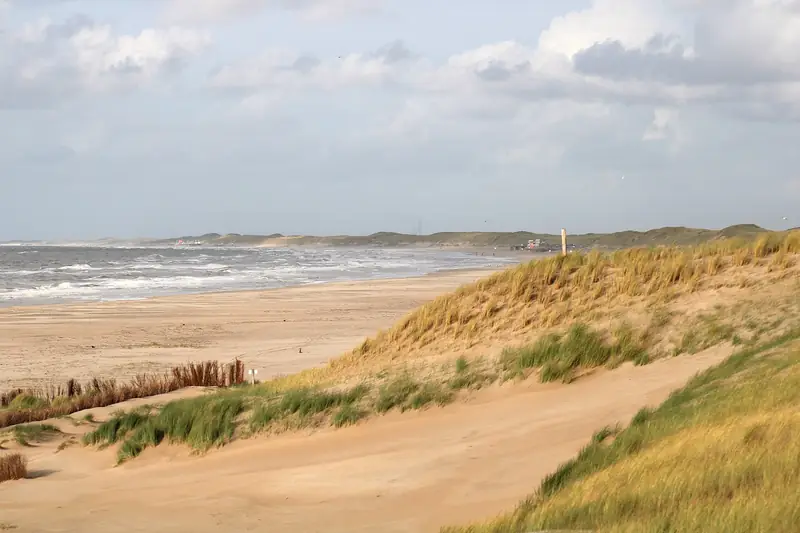
Nature nearby
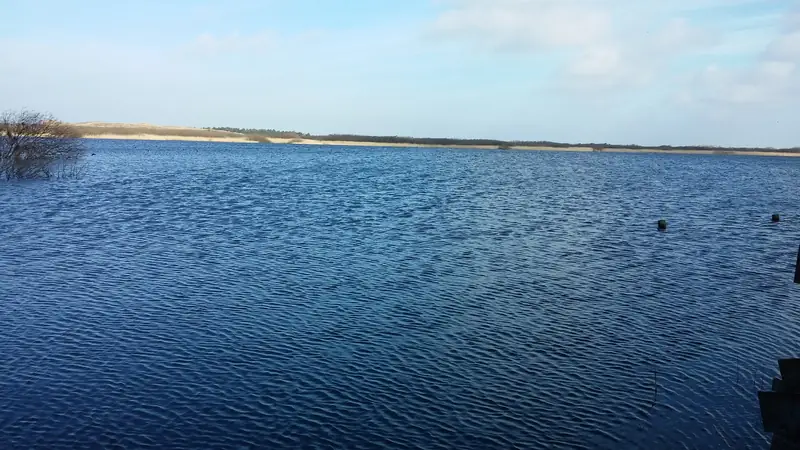
Zwanenwater
The Zwanenwater is a 600 hectare dune area belonging to Natuurmonumenten, the Dutch nature conservation society, a good two kilometres south of Callantsoog. It holds two dune lakes, the Eerste Water and the Tweede Water. Entry costs 3.50 euros per person, and members and children under 12 go in free.
2.4 km
Panoramaduin
The Panoramaduin is a viewpoint on the seaward side at Petten, roughly 590 metres as the crow flies north-west of the village centre and a good 800 metres from the Palendorp. It is listed as a viewpoint in OpenStreetMap and has its own Wikidata item, Q124326971. How high it is appears in no source we could check.
7.5 km